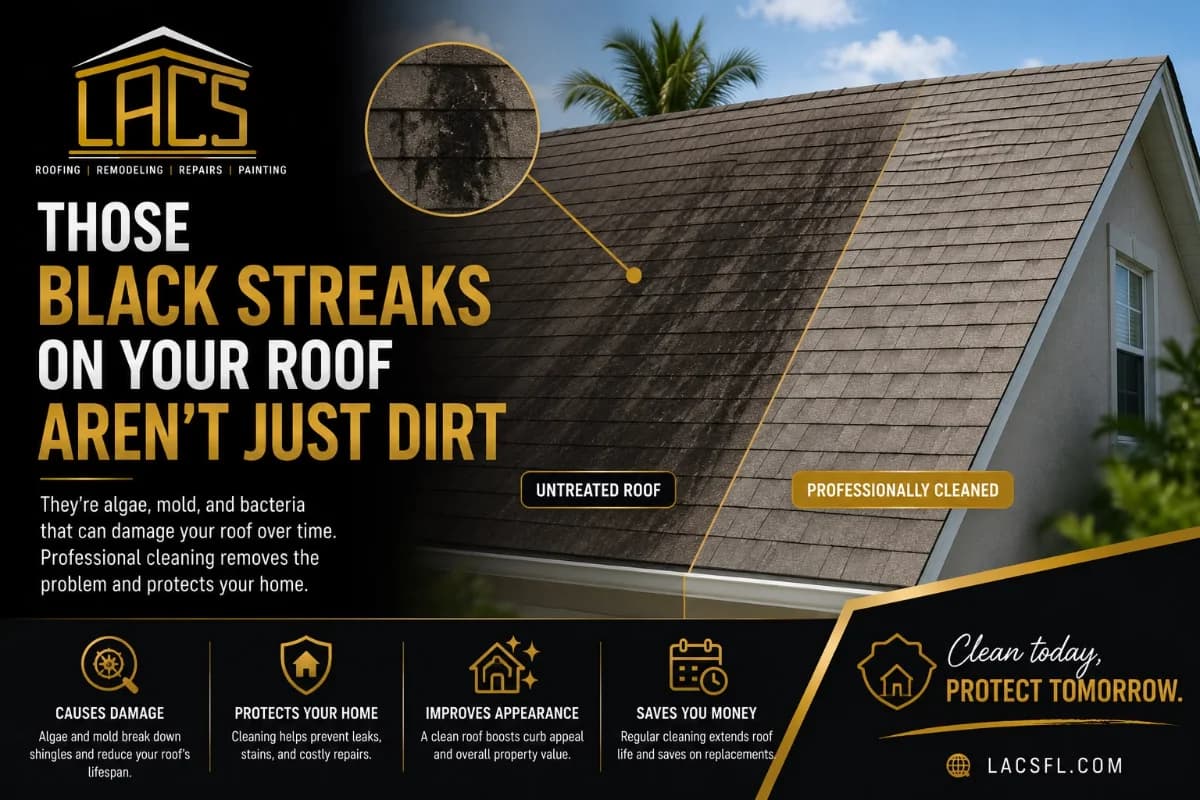
Those Black Streaks on Your Roof Aren’t Just Dirt
Black roof streaks are usually algae (Gloeocapsa magma), not dirt. Learn why it spreads, why pressure washing is risky, and how soft washing helps.
Are Those Black Roof Streaks Just Dirt — Or Are They Quietly Destroying Your Shingles?
They’re usually not dirt. Most black streaks on asphalt shingles are Gloeocapsa magma, a moisture-loving organism often called algae that feeds on shingle filler and traps water on the roofing surface. Left alone, it can accelerate granule loss, shorten shingle life, and make your roof run hotter.
Introduction
Most homeowners look up, see black streaks, and assume the roof is just “getting old” or collecting grime. That belief is exactly why the problem spreads: what looks like dirt is often living growth that thrives in moisture and shade, then creeps across shingles one rainy season at a time.
Once you understand what those streaks really are, your decisions change fast. You stop considering risky pressure cleaning, you start watching for early warning patterns (like north-facing slopes and shaded corners), and you treat roof cleaning as roofing maintenance, not cosmetic work. That shift protects your shingles, your curb appeal, and potentially your roof’s lifespan.
Your shingles already look stained and uneven from the street, and you’re probably worried the roofing is aging faster than it should right now.
If you wait, that growth keeps holding moisture on the roof surface and can speed up granule loss—LACS solves this with safe soft-wash cleaning that removes stains without damaging shingles.
Talk to LACS now and stop the streaks before another wet season bakes them deeper into your roofing.

Table of Contents
- What black streaks on shingles actually are
- Why some roofs get streaks faster than others
- Do black streaks damage roofing or just look bad
- Why pressure washing shingles is a costly mistake
- How professional soft washing removes algae without harming shingles
- How to keep roof streaks from coming back
- When stains mean something bigger than algae
What black streaks on shingles actually are
Those dark streaks are most often Gloeocapsa magma, a blue-green organism commonly called algae that grows on asphalt shingles. It spreads by airborne particles, settles where moisture lingers, and creates black staining as it colonizes the roofing surface. It’s not normal dirt—and it won’t rinse off like dirt.
You’ll usually notice the streaks forming in vertical trails because water carries the organisms down the roof as rain runs off. On many roofs, it starts subtly: a faint dark haze near the top ridge or in one corner, then deepens into defined lines.
A quick way to tell “dirt” from biological growth: dirt tends to be patchy and random; algae streaks often look like drips or runs, especially below shaded areas.
Common identifiers homeowners report:
- Black or very dark brown streaks on shingles
- More staining on shaded slopes (often north-facing)
- Faster growth near tree cover where moisture stays longer
To better understand why these stains are living growth (not grime) and how they spread across neighborhoods, see also the article What Those Black Streaks on Your Roof Really Mean.
Why some roofs get streaks faster than others
Roofs don’t stain equally because algae growth depends on moisture time, not just rain. If one section of your roofing stays damp longer each day—because of shade, poor airflow, or morning dew—it becomes the perfect surface for black streaks to take hold on shingles.
Think of it like this: two homes can get the same rainfall, but one roof dries by 10 a.m., while another stays wet until noon. That extra damp window is when Gloeocapsa magma thrives.
Factors that commonly accelerate streaking:
- Shade from trees (especially over valleys and roof corners)
- North-facing slopes that receive less direct sun
- Humid climates where dew is frequent and evaporation is slow
- Roof design traps like valleys that hold runoff longer
- Older asphalt shingles with more exposed filler and rougher surface texture
Also, algae doesn’t respect property lines. Airborne spread means if nearby roofs are heavily stained, your clean roof can become the next landing pad.
To better understand how local climate and shade patterns fuel roof staining in humid areas, see also the article Roof Cleaning Moncks Corner, SC | Remove Black Streaks.
Do black streaks damage roofing or just look bad
Black streaks start as an appearance problem—but they can become a roofing performance problem because algae holds moisture against shingles. That moisture can speed up granule wear, reduce reflectivity (more heat absorption), and contribute to premature aging of asphalt shingles over time.
The key issue isn’t that algae instantly “eats through” a roof. It’s that it changes the environment on the shingle surface: wetter longer, hotter in sun, and more prone to losing protective granules.
Here’s what can happen when staining is ignored:
- Granule loss accelerates: those granules protect shingles from UV and weather
- Heat increases: darker surfaces absorb more sunlight, stressing roofing materials
- Stains deepen: older colonies become harder to remove cleanly
- Inspection gets harder: heavy staining can hide early shingle defects
Homeowners also underestimate resale impact. A stained roof signals “deferred maintenance,” even if the structure is fine.
To better understand how these streaks can shorten shingle lifespan and create real costs beyond curb appeal, see also the article Those Black Streaks on Your Roof Aren't Just Dirt.
Why pressure washing shingles is a costly mistake
Pressure washing a roof is one of the fastest ways to turn a stain problem into a roofing repair problem. High pressure can strip granules off asphalt shingles, force water under shingle edges, and weaken seals—especially on older roofs where materials are already brittle.
If you’ve ever seen “clean stripes” after pressure washing, that’s not success—that’s often missing granules exposing fresh asphalt. The roof may look better briefly while becoming less durable.
Pressure washing risks include:
- Granule blow-off, reducing shingle lifespan
- Water intrusion, especially around penetrations and flashing
- Lifted tabs, making shingles more vulnerable to wind damage
- Uneven results, because algae roots aren’t reliably killed by water alone
Even “low pressure” from a homeowner-grade machine can be too aggressive when concentrated at close range. Roofing manufacturers and experienced cleaners typically recommend chemical treatment plus gentle rinse rather than blasting.
To better understand why soft wash methods are preferred over trial-and-error cleaning approaches, see also the article Most people think those black streaks on their roof are just ....
How professional soft washing removes algae without harming shingles
Soft washing removes black streaks by killing the organism first, then letting weathering or gentle rinsing lift staining without damaging shingles. The goal isn’t to “scrub” your roofing clean—it’s to treat the biological growth so it releases from the shingle surface safely.
A typical professional process looks like this:
- Pre-check of roofing condition (loose granules, lifted shingles, fragile areas)
- Protection steps (plants pre-watered; sensitive areas covered as needed)
- Application of cleaning solution designed for organic growth removal
- Dwell time so Gloeocapsa magma dies at the root level
- Low-pressure rinse or controlled rinse strategy depending on staining severity
- Post-check for uniform results and runoff management
This matters because algae is not just sitting there like dirt—it’s bonded through biofilm behavior. Killing it first prevents fast regrowth and reduces how aggressive you need to be physically.
To better understand what homeowners should expect from low-pressure chemical treatment and why it aligns with industry guidance, see also the article Soft Wash Roof Cleaning That Follows Industry Guidance.
How to keep roof streaks from coming back
You can’t control humidity or every spore in the air—but you can make your roof less welcoming to algae growth. Prevention works best when you combine smart maintenance with small upgrades that change how long moisture sits on shingles.
Practical prevention options include:
- Trim back branches to increase sun exposure and airflow over roofing
- Keep gutters clear so water doesn’t back up onto roof edges
- Reduce shaded damp zones around valleys and persistent wet corners
- Consider algae-resistant shingles when reroofing (helpful in high-humidity regions)
- Discuss whether zinc/copper strategies fit your roof design (installation details matter)
Also set expectations: even well-maintained roofs may develop light staining again over time depending on climate. The win is preventing heavy black streaks from becoming entrenched for years.
A simple homeowner habit helps: take two photos of each slope every season (same angles). You’ll spot new streak patterns early—before they dominate the entire roof.
To better understand how prevention compares to repeated removal—and what long-term maintenance typically looks like, see also the article Black streaks on your roof: Algae causes, solutions and ....
When stains mean something bigger than algae
Not every dark mark is Gloeocapsa magma. Some stains point to different issues—like trapped moisture from ventilation problems, debris breakdown in roof valleys, or localized damage where water flow behaves abnormally. The danger is assuming “it’s just algae” while missing early roofing failure signs.
Pay attention if you see:
- Dark staining concentrated around one penetration (pipe boot, vent)
- A single area getting worse fast after storms
- Shingles curling, cracking, or slipping near stained zones
- Interior symptoms like musty odors or ceiling discoloration
In those cases, cleaning alone might improve appearance but won’t solve the underlying cause. You may need both: a careful inspection for water pathways plus appropriate cleaning once repairs are addressed.
If you’re unsure whether you’re seeing normal biological growth or something else, start by documenting patterns (where it begins, how it runs after rain). That information helps a professional diagnose whether it’s purely surface-level or tied to drainage/roofing details.
To better understand how homeowners evaluate cleaning versus calling a roofer—and what questions come up most often, see also the article Our roof has black streaks. is there any way to clean them ....
Is Roof Cleaning Actually Worth It — Or Is It Just Cosmetic?
Roof cleaning is worth it when black streaks are caused by biological growth because you’re removing an organism that holds moisture against shingles and accelerates visible aging of roofing materials. It’s not magic—and it won’t reverse old shingle wear—but it can slow down avoidable deterioration while restoring curb appeal quickly.
The value is highest when you act early: light-to-moderate staining responds more predictably to soft washing than thick, years-old buildup. It’s also worth it before selling your home or refinancing photos are taken; buyers read stained roofs as neglected maintenance even when leaks aren’t present. If your roof is already near end-of-life (curling tabs, widespread granule loss), cleaning may be secondary to planning replacement—but even then it can help inspections be more accurate by revealing what’s actually happening on the shingle surface.
With Roof Cleaning or Without Roof Cleaning: What’s the Difference?
With soft-wash roof cleaning:
- Shingles look uniform again; curb appeal improves fast
- Biological growth is killed instead of just “rinsed”
- Moisture retention decreases as colonies are removed
- Future inspections become clearer because stains don’t hide defects
Without roof cleaning:
- Streaks spread season after season across roofing slopes
- Darkened areas absorb more heat and stay damp longer
- Staining becomes harder to remove as buildup thickens
- Home value perception drops because buyers assume deeper problems
Practical conclusion: if your shingles are structurally sound, cleaning sooner prevents heavier staining later—and avoids risky DIY methods that damage roofing materials.
📌 Decision If you’re seeing black streaks on shingles right now, treat it as active growth—not harmless dirt—because every wet month it sits there increases moisture retention and speeds up visible aging on your roofing surface. I’ve watched homeowners delay until stains harden into permanent-looking shadows, then panic and blast their roofs with pressure washers that strip granules and create real damage. Stop guessing: get the roof assessed and cleaned correctly while it’s still a straightforward fix, not an avoidable repair bill.
Conclusion
Those black streaks aren’t a cosmetic mystery—they’re usually biological growth living on your shingles and thriving wherever moisture lingers on your roofing surface. The safest path isn’t pressure washing; it’s identifying what you’re dealing with, removing it using soft-wash methods that protect asphalt shingles, then reducing conditions that help it return.
If you want a deeper breakdown of what those stains indicate—and when they signal something beyond algae—keep learning before you act fast with the wrong tool. To better understand the meaning behind common stain patterns and when to take action, see also the article What Those Black Streaks on Your Roof Really Mean.
Your shingles already look stained and uneven from the street, and you’re probably worried the roofing is aging faster than it should right now.
If you wait, that growth keeps holding moisture on the roof surface and can speed up granule loss—LACS solves this with safe soft-wash cleaning that removes stains without damaging shingles.
Talk to LACS now and get a clear plan before another rainy stretch locks those streaks in deeper.