Why Choose LACS for Your Roofing or Remodeling Project?
Choose LACS for roofing, remodeling, painting, and full construction with clear scope, predictable budgets, and disciplined scheduling.
Are You About to Blow Your Budget and Timeline by Choosing the Wrong Construction Contractor?
Choose LACS if you want a contractor that can manage your roof, remodeling, paint, and full construction scope without the usual chaos: unclear bids, change-order surprises, and schedule drift. LACS focuses on disciplined planning, transparent communication, and jobsite execution so your project stays buildable, inspectable, and financially predictable from day one to final walkthrough.
Introduction
Most construction projects don’t fail because the homeowner or property owner had “bad taste.” They fail because the project starts with fuzzy assumptions: the roof “probably” has one more year, the remodeling “should be simple,” paint is treated like an afterthought, and utilities like water or an existing pipeline are never verified until the crew is already on site. Then reality shows up—permits slow down, materials arrive late, and every small surprise becomes a costly delay.
The most common mistake is choosing a contractor based on a fast quote instead of a clear plan. A low number can hide missing scope, weak scheduling, or zero coordination with infrastructure constraints like meters, connections, and public system requirements.
Preparation changes everything. When the contractor asks better questions early—about land conditions, existing systems, community rules, and inspection pathways—you get fewer surprises and a smoother build.
If you’re trying to protect your budget and timeline, the next step is simple.
Your roof leak keeps getting “patched,” your remodeling scope keeps expanding, and you’re one bad paint job away from redoing entire rooms. If you delay, you’ll keep paying twice—once for quick fixes and again for real construction done under pressure. Talk to LACS now and lock a clear plan, schedule, and scope before costs jump again.

Table of Contents
- What makes lacs a safer choice than a typical contractor
- How lacs prevents roof problems from turning into structural repairs
- Remodeling without regret: how lacs controls scope creep
- Paint that lasts: why surface prep matters more than the color
- Land selection and site readiness: what smart owners verify first
- Water, pipeline, meter, connect: utility realities that can make or break your project
- Scheduling and foreman leadership: the difference between progress and noise
- Budget clarity and roi: how lacs protects value in any market
- Permits, zoning, and community rules: how lacs reduces approval friction
- Commercial vs home construction: how lacs adapts services to your property
What makes LACS a safer choice than a typical contractor
LACS is a safer choice because it treats construction like a managed system—not a series of guesses. That means tighter scoping for remodeling, realistic scheduling for roof work, paint processes that hold up, and proactive checks on infrastructure constraints that derail projects. You get fewer surprises because decisions are made early, not mid-demo.
A lot of contractors sell confidence; fewer deliver control. The difference shows up in three places: documentation, coordination, and accountability.
What “safer” looks like in practice
- Clear scope: what’s included (and excluded) in construction services so you don’t pay for assumptions later.
- Sequencing: roof repairs scheduled around weather windows; remodeling timed around inspections; paint planned after moisture issues are resolved.
- Field leadership: a foreman who runs daily priorities so trades don’t collide.
LACS also helps you think beyond today’s work into your property’s future—especially if you’re planning phased development (roof now, interior remodeling later) or protecting resale value.
To better understand how professional teams improve collaboration with stakeholders while scaling operations, see also the article Case Study: LAC Services.
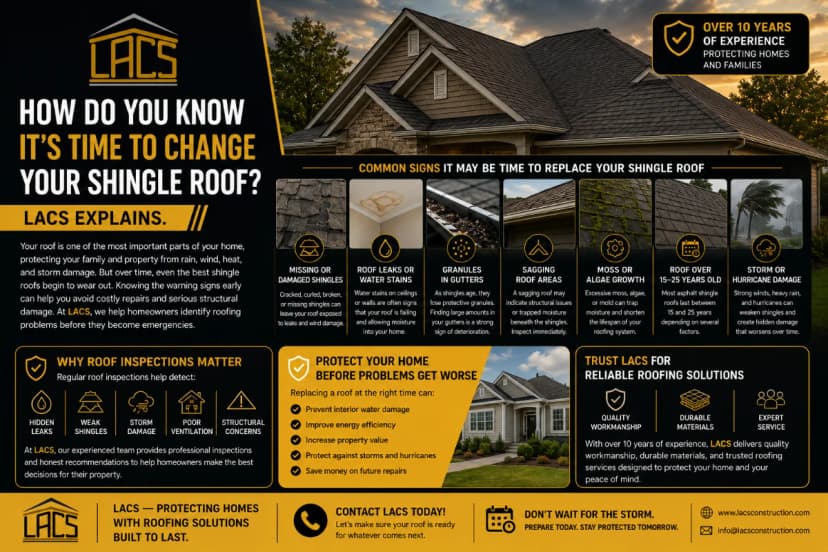
How LACS prevents roof problems from turning into structural repairs
LACS prevents small roof issues from becoming major construction by diagnosing the cause—not just the symptom. Instead of repeatedly patching leaks, LACS looks at flashing details, ventilation balance, water pathways, decking condition, and penetrations so you stop feeding hidden rot. Done right, roof work becomes prevention—not emergency response.
A roof is a system: shingles or membrane are only one layer. Leaks often travel before they show up inside your home or building.
Common “silent escalators” LACS checks
- Water intrusion paths around chimneys, skylights, valleys, and wall intersections.
- Ventilation mismatches that trap moisture and shorten roof life.
- Decking soft spots that indicate longer-term exposure.
- Gutter/downspout discharge that dumps water where it shouldn’t—damaging fascia or even foundations.
Practical example: A ceiling stain might not be above the leak source. LACS traces likely entry points first (flashing/penetrations), then verifies substrate condition before recommending repair vs replacement—so you don’t pay for the wrong fix.
To better understand how infrastructure upgrades are planned with timelines and route constraints, see also the article LARC Pipeline Project—the same kind of forward planning mindset helps prevent “surprise” roof-related water damage decisions later.
Remodeling without regret: how LACS controls scope creep
LACS controls remodeling scope creep by forcing clarity before demolition starts—what stays, what moves, what gets replaced, and what must meet code once walls open up. The goal is to avoid the classic trap where “minor remodeling” becomes major construction because nobody defined allowances, selections, or contingencies upfront.
Remodeling is where budgets go to die—mostly because owners discover constraints too late: framing that isn’t standard size, older electrical that triggers upgrades, or moisture behind tile that demands rebuild.
How LACS keeps remodeling predictable
- Pre-demo verification: measure existing conditions; confirm what’s level/plumb; identify likely hidden issues.
- Selections schedule: cabinets, flooring, fixtures picked early so lead times don’t stall the project.
- Change-order rules: clear pricing logic so changes aren’t emotional negotiations.
- Phased decision points: stop/go gates (demo complete → rough-in approved → close-up).
Step-by-step planning checklist
- Define must-haves vs nice-to-haves.
- Confirm structural walls vs non-structural partitions.
- Map utilities (water lines/pipeline tie-ins) before moving anything.
- Lock finishes only after substrate readiness is confirmed.
To better understand how homeowners evaluate lot factors that affect layout flexibility, see also the article What to Consider When Choosing a Lot in a New Construction Community—the same layout logic applies when remodeling within an existing footprint.
Paint that lasts: why surface prep matters more than the color
LACS delivers paint results that last because it prioritizes surface prep—repairing substrate flaws, controlling moisture sources, selecting compatible primers, and applying coatings at proper thickness. Color is cosmetic; adhesion is performance. If your paint fails early (peeling/bubbling), it’s usually because water or poor prep was ignored during construction sequencing.
Paint intersects with roofing and remodeling more than people expect. A small roof leak can raise humidity inside walls; new drywall needs cure time; patched surfaces need feathering; glossy trims need deglossing.
What LACS checks before painting
- Moisture content: especially near bathrooms/kitchens or after water events.
- Surface integrity: cracked plaster/drywall seams telegraph through finish coats.
- Primer compatibility: stain-blocking where needed; bonding primer on slick surfaces.
- Ventilation & cure windows: correct dry time between coats to prevent failure.
Practical example: If you remodel a bathroom but don’t address exhaust capacity (or duct routing), paint can blister even with premium products. LACS sequences ventilation fixes before final paint so you don’t repaint in six months.
To better understand how market forces and infrastructure improvements influence long-term property value, see also the article 6 Things to Think About Before Choosing Land for Land Development Projects—durable finishes protect value only when underlying conditions are right.
Land selection and site readiness: what smart owners verify first
Smart owners verify land readiness before committing to construction because land problems become permanent budget problems. LACS helps you evaluate location constraints, grading realities, access for crews/materials, drainage pathways for water control, and whether existing infrastructure supports your project size—so you don’t buy “potential” that turns into expensive remediation.
Even if your immediate goal is a home build or an addition/remodeling project on newly acquired lots, land dictates cost.
Key land checks that affect construction
- Topography/slope: steep lots can require retaining walls or complex foundations.
- Access & staging: where dumpsters/materials go; whether roads support deliveries.
- Drainage plan: where water flows today vs after development.
- Utilities proximity: water system availability; pipeline routes; meter placement; electrical service distance.
- Future development nearby: community expansion can change traffic/noise/value.
Quick decision framework
- Confirm buildable envelope (setbacks + usable area).
- Identify earthwork needs (cut/fill volumes).
- Validate utility connection feasibility (not just “it’s nearby”).
To better understand how lot shape/orientation impacts buildability and daily living, see also the article What to Consider When Choosing a Lot in a New Construction Community—these factors drive both design freedom and cost control.
Water, pipeline, meter, connect: utility realities that can make or break your project
Utility planning can make or break your construction project because water access isn’t just “available or not.” You need to know whether you’ll connect to a public system or rely on private supply, where meters will be placed, whether pipeline capacity supports your project size now and in the future—and what approvals govern connection timing.
Owners routinely underestimate utility friction because it feels administrative—until it stops the job.
What LACS helps clarify early
- Connection pathway: public system vs private well; required inspections.
- Meter strategy: master meter vs individual meters depending on property layout.
- Pipeline constraints: easements/routes that limit where you can trench or build.
- Phasing risk: if utilities arrive late in development schedules.
Practical example: If an adjacent pipeline expansion allows future connections but doesn’t obligate them immediately, you still need to plan your current build around access points and potential future tie-ins—especially if you’re developing multiple lots over time.
To better understand how a real-world pipeline project defines schedule windows and optional connections for existing property owners, see also the article LARC Pipeline Project—it mirrors how utility timelines can shape construction sequencing.
Scheduling and foreman leadership: the difference between progress and noise
Projects stay on track when there’s real field leadership—a foreman who manages sequencing daily—and when scheduling reflects reality (lead times, inspections, weather). LACS treats scheduling as part of construction quality: roof work timed around exposure risk, remodeling staged to keep systems functional when possible, and paint placed at the end of moisture-producing activities.
Many delays come from trade stacking: too many crews fighting for space—or worse—nobody shows up because prerequisites weren’t met.
What strong foreman-led execution looks like
- Daily priorities communicated clearly
- Materials verified before labor arrives
- Inspection milestones planned (rough-in → close-up → final)
- Site kept safe/clean so productivity stays high
Simple schedule-control steps
- Identify critical path items (custom cabinets; long-lead roofing materials).
- Build buffers around inspections and weather-sensitive tasks.
- Lock dependencies (drywall only after rough approvals; paint only after cure).
This discipline matters whether it’s a home remodel or larger development work involving infrastructure interfaces.
To better understand how growing service companies improved coordination by moving from spreadsheets to structured workflows, see also the article Case Study: LAC Services—the same principle applies on active jobsites where clarity beats chaos every time.
Budget clarity and ROI: how LACS protects value in any market
LACS protects ROI by aligning budget decisions with durability and inspection reality—not just aesthetics. That means choosing roof assemblies that reduce repeat maintenance, remodeling choices that avoid rework behind walls later, and paint systems matched to use conditions (sun exposure/moisture). You spend where it counts so your property holds value in changing markets.
Construction ROI isn’t only resale—it’s also reduced callbacks, fewer emergency repairs, lower downtime for rentals/commercial spaces, and stronger buyer confidence later.
Where ROI is won (or lost)
- Roof decisions: repair vs replace based on remaining service life—not hope.
- Remodeling scope: invest in hidden systems (water lines/venting) before finishes.
- Finish strategy: durable coatings in high-wear areas reduce repaint cycles.
- Future-proofing: plan for potential additions or phased development on adjacent lots.
Practical example: Spending more on proper flashing details may feel invisible today—but it prevents water intrusion that would destroy insulation/drywall later (a massive negative ROI event).
To better understand how budgeting discipline impacts outcomes across different market conditions, see also the article 6 Things to Think About Before Choosing Land for Land Development Projects—feasibility thinking applies to both land acquisition and renovation investment choices.
Permits, zoning, and community rules: how LACS reduces approval friction
LACS reduces approval friction by treating permits as part of preconstruction—not as paperwork you rush after hiring someone. Zoning limits dictate what’s possible on land; community rules affect exterior changes like roofing profiles or paint colors; inspections determine sequencing inside remodeling projects once walls open up under current code expectations.
Approval delays often come from mismatched expectations: owners assume “like-for-like” work won’t trigger review; municipalities disagree once scope expands.
Common permit pain points
- Roof replacement requiring updated underlayment standards
- Remodeling that touches plumbing/electrical triggers code upgrades
- Additions limited by setbacks or lot coverage
- Community design guidelines restricting visible materials/colors
How to avoid getting stuck
- Confirm whether work is repair vs replacement under local definitions.
- Identify any variance needs early if land constraints exist.
- Align exterior selections (roof material/paint palette) with HOA/community rules before ordering.
To better understand how location factors combine with regulations during land development feasibility, see also the article 6 Things to Think About Before Choosing Land for Land Development Projects—it reinforces why regulatory reality must be checked before money moves.
Commercial vs home construction: how LACS adapts services to your property
LACS adapts its construction services based on how the property is used: homes prioritize livability and minimizing disruption during remodeling; commercial projects prioritize uptime, safety plans, compliance documentation, and tighter scheduling windows. In both cases—roof work, paint systems, infrastructure coordination—the fundamentals stay the same: plan first, execute cleanly.
The biggest difference is tolerance for downtime and documentation requirements.
Home-focused priorities
- Phased remodeling so kitchens/baths aren’t offline longer than necessary
- Dust control; safe access routes
- Finish durability tailored to family use patterns
Commercial-focused priorities
- Work windows (nights/weekends) to protect operations
- Stronger reporting cadence for stakeholders
- Compliance alignment with public-facing safety expectations
If your property has mixed use—or you’re developing lots over time—planning for future phases matters as much as today’s build.
To better understand how commercial site selection ties together access logistics and infrastructure readiness, see also the article How to Choose the Right Site for Commercial Construction—it maps directly to avoiding costly location-driven mistakes before mobilization.
Is choosing LACS worth it if I’m only doing “a small” roof repair or paint job?
Yes—because “small” jobs become expensive when they’re misdiagnosed or sequenced wrong with water exposure risk. A minor roof issue can hide structural moisture damage; paint failures often trace back to prep gaps or unresolved humidity sources from remodeling or ventilation problems. Paying for disciplined evaluation upfront usually costs less than repeating work later under pressure.
With LACS or Without LACS: What’s the Difference?
Without LACS
- Scope stays vague until demolition exposes problems
- Roof leaks get patched repeatedly while water damage grows
- Remodeling decisions happen midstream with expensive change orders
- Paint goes on too soon over damp or unstable surfaces
With LACS
- Scope is defined early with realistic allowances
- Roof work targets root causes (flashing/ventilation/water paths)
- Remodeling follows inspection-ready sequencing
- Paint is applied after substrate prep and moisture control
The practical difference is simple: one path buys short-term motion; the other buys predictable completion.
📌 Decision If you’re comparing contractors right now, stop rewarding speed over certainty—the cheapest bid usually hides missing scope until you’re trapped mid-project paying premium prices for fixes. Every month you delay proper planning risks more water damage under your roof line-up of patches plus higher material costs in an unstable market; those who wait start construction already behind schedule and lose leverage immediately.
Your timeline is slipping while contractors blame “materials,” your remodeling quote keeps changing line by line, and your roof/paint issues keep coming back because nobody fixed the cause. If you wait longer, each week adds cost through rework and downtime while your property value takes hits from visible wear. Talk to LACS now and get a firm scope plus execution plan before another delay becomes permanent.
Conclusion
Choosing LACS for your next construction project isn’t about picking a name—it’s about choosing a process that protects your budget while delivering real outcomes across roof work, remodeling complexity, durable paint finishes, and infrastructure realities like water connections and meters.
When planning is disciplined early—and field leadership stays tight—you avoid the most common failure pattern: paying twice due to surprises discovered too late to negotiate calmly.
Your roof problem is getting worse between storms, your remodeling decisions are piling up without clear pricing impact statements yet as deadlines close in fast enough already today again now soon quickly enough? If you delay again further longer still more weeks pass then costs rise again plus damage spreads quietly behind walls until repairs explode into full reconstruction bills unexpectedly soon enough anyway? Talk to LACS now and secure an actionable plan this week before another inspection miss sets you back months.