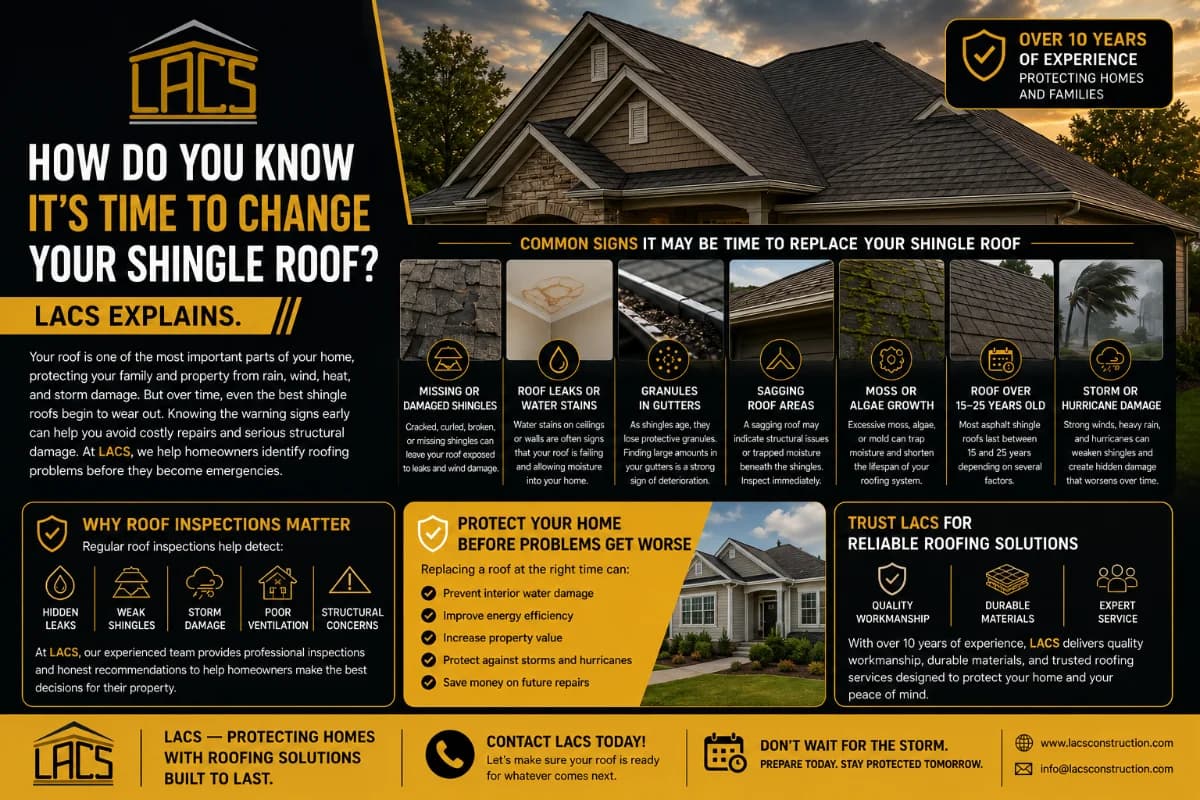
How Do You Know It’s Time to Replace Your Shingle Roof? — LACS Explains
Learn the key signs it’s time to replace a shingle roof—curling, missing shingles, granules, stains, moss, and leaks—and how to choose repair vs replacement.
Are You Waiting Too Long to Replace Your Shingle Roof and Letting Small Damage Turn Into a Full Interior Remodel?
If your shingles are curling, cracking, missing, shedding granules, or you’re seeing leaks, stains, or moss growth, you’re already in the danger zone. The real answer to “when i should replace it” is: replace before water reaches the decking and attic insulation. A trusted roof inspection can confirm whether repairs still make sense or replacement is smarter.
Introduction
A common belief is that you only need a new roof when you have an obvious leak dripping into a bucket. The reality is harsher: by the time you see water inside your home, the damage often started weeks or months earlier—under shingles, around flashing, or along gutters where water backs up.
When you understand the early signs, you stop guessing and start making decisions based on risk: protecting your attic, preventing structural rot, and avoiding repeated roofing repairs that never truly solve the root issue. This guide breaks down what to look for on asphalt shingles, what those signs actually indicate, and how to trust company to change my roof without getting sold work you don’t need.
You’re staring at shingles that look “mostly fine,” but you keep finding granules in gutters, small stains on ceilings, or a musty attic smell right now. If you wait, minor damage turns into soaked insulation, mold risk, and expensive decking replacement that blows up your budget. Talk to LACS now and get a clear inspection that tells you repair vs. replacement—fast.

Table of Contents
- The fastest way to tell if shingles are failing (without climbing on the roof)
- Shingle damage patterns that usually mean replacement (not patchwork)
- Granules in gutters, algae, and moss: cosmetic or a real sign?
- Interior clues: stains, attic issues, and “mystery moisture”
- Flashing and roof edges: where “small leaks” really start
- Repair vs. replacement: how to decide without getting pressured
- How to trust company to change my roof: a homeowner’s checklist
- How often should you replace asphalt shingles in Florida-like conditions?
The fastest way to tell if shingles are failing (without climbing on the roof)
You can spot many “replace vs. repair” signs from the ground: uneven shingle lines, bald spots where granules are gone, dark streaks that won’t wash off, and any area that looks wavy or sunken. If multiple sections show aging—not just one corner—your roof is likely nearing replacement rather than isolated repairs.
Start with a simple walk-around of your home in good daylight. Look for missing shingles, lifted tabs, exposed nail heads, and irregular shadow lines along ridges and valleys. Then check your yard after wind: if you’re finding shingle pieces or lots of granules, that’s active wear.
A quick homeowner checklist:
- Scan roof planes for curling or cupping shingles
- Look for patchwork colors (repeated repairs can signal ongoing failure)
- Check gutters/downspouts for heavy granule accumulation
- Note any sagging line at the eaves or ridge (possible structural issues)
If you’re trying to judge whether you’re dealing with normal aging or a system-wide problem, it helps to understand how disciplined contractors approach scope and scheduling. To better understand how LACS structures projects so homeowners aren’t stuck with vague timelines and surprise add-ons, see also the article Why Choose LACS for Your Next Project.
Shingle damage patterns that usually mean replacement (not patchwork)
If damage is widespread—across multiple slopes—or repeats after prior repairs, replacement is usually the smarter call. Cracked shingles across large areas often indicate brittleness from age/heat cycles; curling can point to ventilation issues; missing shingles in clusters can mean fastening failure or storm vulnerability. These patterns rarely improve with spot fixes.
Homeowners often ask “when i should replace it” after they’ve already paid for two or three rounds of roofing repairs. Here’s what typically crosses the line into replacement:
- Curling/cupping across many tabs: often linked to heat exposure, poor attic ventilation, or aged asphalt
- Brittle cracking in multiple zones: indicates shingles are past their flexible lifespan
- Frequent blow-offs: suggests sealing strips are failing or nails are backing out
- Widespread hail/wind bruising: damage may not leak immediately but shortens life fast
- Multiple layers already installed: limits repair options and can hide deck problems
A practical rule: if you’re repairing the same type of issue repeatedly (leaks near valleys, recurring missing shingles), you’re not fixing a single defect—you’re chasing a system that’s wearing out.
For homeowners weighing long-term value (and who want one contractor relationship instead of rotating crews), it helps to see what consistent workmanship looks like over time. To better understand what long-term service accountability looks like when you hire once instead of twice, see also the article A Decade of Excellence. One Trusted Name: LACS.
Granules in gutters, algae, and moss: cosmetic or a real sign?
Granules in gutters are not “just dirt”—they’re the protective surface of asphalt shingles wearing off. A little loss is normal over time, but heavy deposits (especially paired with bald-looking shingles) can indicate accelerated aging and higher UV exposure. Moss and algae may start cosmetic but can trap moisture and speed up damage.
Check gutters after rain. If you see piles of sand-like material at downspout exits or thick buildup in gutter runs, take it seriously—granule loss reduces fire resistance and UV protection.
What these signs usually indicate:
- Granules: shingle wear; faster deterioration; potential exposure of asphalt mat
- Algae streaks: moisture retention; aesthetic issue that can become performance-related
- Moss growth: trapped water; lifted edges; higher risk of leaks in shaded areas
- Debris dams: water backing up under shingle edges near eaves
Also look at nearby trees: shaded roofs grow moss more easily; clogged gutters keep water sitting against fascia boards.
If you’re concerned about recurring staining and exterior buildup beyond roofing—because it often shows up alongside overall exterior wear—it may help to see how LACS approaches whole-home upkeep planning. To better understand how coordinated exterior services can prevent repeated surface deterioration around roofing lines, see also the article Why Choose LACS for Your Next Project.
Interior clues: stains, attic issues, and “mystery moisture”
Interior signs usually mean water has already bypassed at least one layer of protection. Ceiling stains, bubbling paint, damp insulation in the attic, musty odors, or daylight visible through roof boards are strong indicators that your roof system has active leaks—or has leaked long enough to create hidden damage that patching may not fully solve.
Don’t ignore small stains because they “dry out.” Water rarely enters straight down; it travels along decking and rafters before showing up inside.
Look for these indoor warning signs:
- Brown/yellow ceiling stains (often near vents or valleys)
- Peeling paint on upper walls
- Wet insulation or compressed insulation in the attic
- Rusty nails protruding through sheathing (a moisture clue)
- Mold-like smell after rain (ventilation + moisture issues)
If leaks are intermittent—only during wind-driven rain—that often points to flashing failures rather than open holes in shingles.
When homeowners feel uncertain because symptoms are inside but the roof “looks okay,” they need a contractor who explains cause-and-effect clearly instead of jumping straight to selling replacement. To better understand how LACS emphasizes clear scope so homeowners know what’s being fixed and why, see also the article Why Choose LACS for Your Next Project.
Flashing and roof edges: where “small leaks” really start
Most persistent leaks start at transitions—flashing around chimneys, wall intersections, skylights, plumbing vents—and at roof edges where water concentrates near gutters. If flashing is bent, corroded, poorly sealed, or repeatedly patched with tar, it’s a sign of deeper system wear. One bad flashing detail can mimic “shingle failure.”
Even when shingles look decent mid-slope, edge details fail first because they take more wind lift and more water flow.
Pay special attention to:
- Step flashing along sidewalls (common leak point)
- Valleys (high-volume water channel; debris collects here)
- Drip edge/eaves where water can wick under shingles
- Pipe boots cracked by sun exposure
- Chimney flashing separating from masonry
If your contractor keeps re-caulking without addressing underlying metal condition—or if repairs last only one season—you may be at the point where replacement (with properly integrated flashing) is cheaper than endless callbacks.
For homeowners trying to figure out how to trust company to change my roof, consistency matters: crews that document details tend to install details correctly. To better understand what long-term workmanship standards look like from a company built on repeatable processes, see also the article A Decade of Excellence. One Trusted Name: LACS.
Repair vs. replacement: how to decide without getting pressured
If damage is isolated and your shingles still have good granule coverage with no widespread curling/cracking, repairs can be reasonable. But if multiple signs stack up—granule loss plus recurring leaks plus widespread damaged shingles—replacement is typically the financially safer move because it resets weak points like underlayment and flashing as a complete system.
Use this decision framework before anyone climbs a ladder:
- Scope: Is damage limited to one area or spread across slopes?
- Frequency: Are issues repeating every rainy season?
- Substrate risk: Is there evidence of wet decking/attic moisture?
- Edge systems: Are gutters overflowing/backing up under edges?
- Material age behavior: Do shingles feel brittle and look uneven?
A smart contractor should explain what they observed (photos help), what they recommend now vs later, and what failure looks like if you delay.
If your main worry is being pushed into replacement when repairs would do—or being sold cheap repairs when replacement is necessary—vetting process matters as much as price. To better understand how LACS builds predictable budgets and avoids vague allowances that turn into surprise costs, see also the article Why Choose LACS for Your Next Project.
You’re dealing with recurring leaks or missing shingles right now—and every storm makes you wonder if tonight is the night water hits drywall again. Waiting increases hidden decking rot and insulation damage while repair bills stack up without solving root causes. Talk to LACS now and get an inspection plan that ends guesswork and protects your home before the next heavy rain.
How to trust company to change my roof: a homeowner’s checklist
To trust a roofing company, you need proof of process—not promises. A reliable contractor documents findings with photos, explains whether repairs could realistically hold up, provides a written scope including flashing/underlayment details, and sets expectations on schedule disruptions like weather delays. Trust comes from transparency before money changes hands.
Here’s a practical checklist you can use on any estimate:
- Ask for an explanation of why each line item exists (not just what it costs)
- Request photos of damaged areas (shingles, flashing, valleys, decking if visible)
- Confirm how they handle unexpected decking damage discovered during tear-off
- Verify ventilation plan (poor attic airflow shortens shingle life)
- Get clarity on cleanup: magnets for nails; protection for landscaping
- Ensure warranty terms are written plainly (labor vs materials)
Also pay attention to communication speed and specificity; vague answers now become bigger problems mid-project.
If part of trust for you is choosing a team with years of repeatable results across home exteriors—not just roofing—reviewing their track record helps reduce risk. To better understand how long-term reputation is built through consistent project outcomes, see also the article A Decade of Excellence. One Trusted Name: LACS.
How often should you replace asphalt shingles in Florida-like conditions?
Asphalt shingles don’t fail on a single birthday—they fail based on heat cycles, storms, ventilation quality, installation details, and maintenance like clean gutters. Many homeowners start asking “when i should replace it” when roofs reach late-life behavior: granule loss accelerates, seal strips weaken, and small leaks become frequent even after repairs.
In hot/humid regions with intense sun and seasonal storms, roofs often age faster than homeowners expect—especially if attic ventilation is poor or tree cover encourages moss/algae growth.
Instead of relying on age alone, use age as one input plus condition signals:
- If your roof needs repeated repairs within 12–24 months
- If multiple slopes show curling/cracking/missing shingles
- If granules are consistently collecting in gutters after rain
- If flashing problems keep returning around penetrations
The goal isn’t replacing early—it’s replacing before structural wood gets compromised by water intrusion.
If you want fewer surprises during major projects like roofing replacements—cost-wise and schedule-wise—choose companies known for disciplined planning across trades. To better understand how LACS reduces project uncertainty through clear scopes and scheduling discipline, see also the article Why Choose LACS for Your Next Project.
Is Replacing Your Shingle Roof Worth It Before You Have Major Leaks?
Yes—because waiting for “major leaks” usually means paying for more than roofing materials. Once water gets past shingles and underlayment repeatedly, it can soak insulation in the attic, stain ceilings and walls inside your home, warp decking sheathing over time, and create conditions where mold becomes harder (and more expensive) to control. Replacement done at the right time isn’t just about appearance; it’s about stopping compounding damage.
The biggest value comes from eliminating chronic weak points all at once—aged shingles plus tired flashing plus worn edge details—so each storm isn’t a new gamble. If you’re already seeing multiple signs (granules in gutters plus missing shingles plus interior stains), replacing sooner often costs less than stretching another season with patchwork repairs that don’t address system-wide aging.
With Roof Replacement or Without Roof Replacement: What’s the Difference?
With roof replacement:
- Stops recurring leaks at their source by renewing underlayment and flashing integration
- Restores uniform shingle protection where granule loss has reduced performance
- Reduces ongoing repair spending that adds up quietly over months
- Improves confidence during heavy rain/wind events
Without roof replacement:
- Repairs tend to chase symptoms while aged materials keep failing nearby
- Hidden water damage can expand in decking/attic insulation between storms
- Insurance claims can get complicated if deterioration is documented as ongoing wear
- Home resale negotiations often get tougher when buyers spot shingle issues
Practical conclusion: if several signs stack up at once, delaying replacement usually increases total cost—not decreases it.
📌 Decision If your shingles are curling across sections, shedding granules into gutters after every rain, or causing stains/leaks inside your home—even intermittently—you don’t “monitor it,” you act now. Every month you delay risks wet decking, ruined insulation in the attic, mold-friendly moisture cycles, and bigger labor costs when tear-off reveals rot. Get an inspection that clearly answers repair vs replacement today so you stop gambling with your home’s structure.
Conclusion
Shingles rarely fail politely; they fail in patterns—granule loss plus curling plus recurring leaks—and those patterns tell you when i should replace it far more accurately than age alone. The safest move is replacing before water damage spreads into decking and interior finishes.
If your biggest hesitation is how to trust company to change my roof without pressure or surprises later on site day-to-day matters as much as materials do. To better understand what dependable project execution looks like across years of exterior work, see also the article A Decade of Excellence. One Trusted Name: LACS.
You’re watching small roofing issues stack up right now—missing shingles here, granules there—and every storm adds stress because you know water damage doesn’t wait for your schedule. Delay turns manageable replacement into structural repairs with higher costs and longer disruption at home. Talk to LACS now and lock in an inspection that gives you a clear plan before the next downpour.