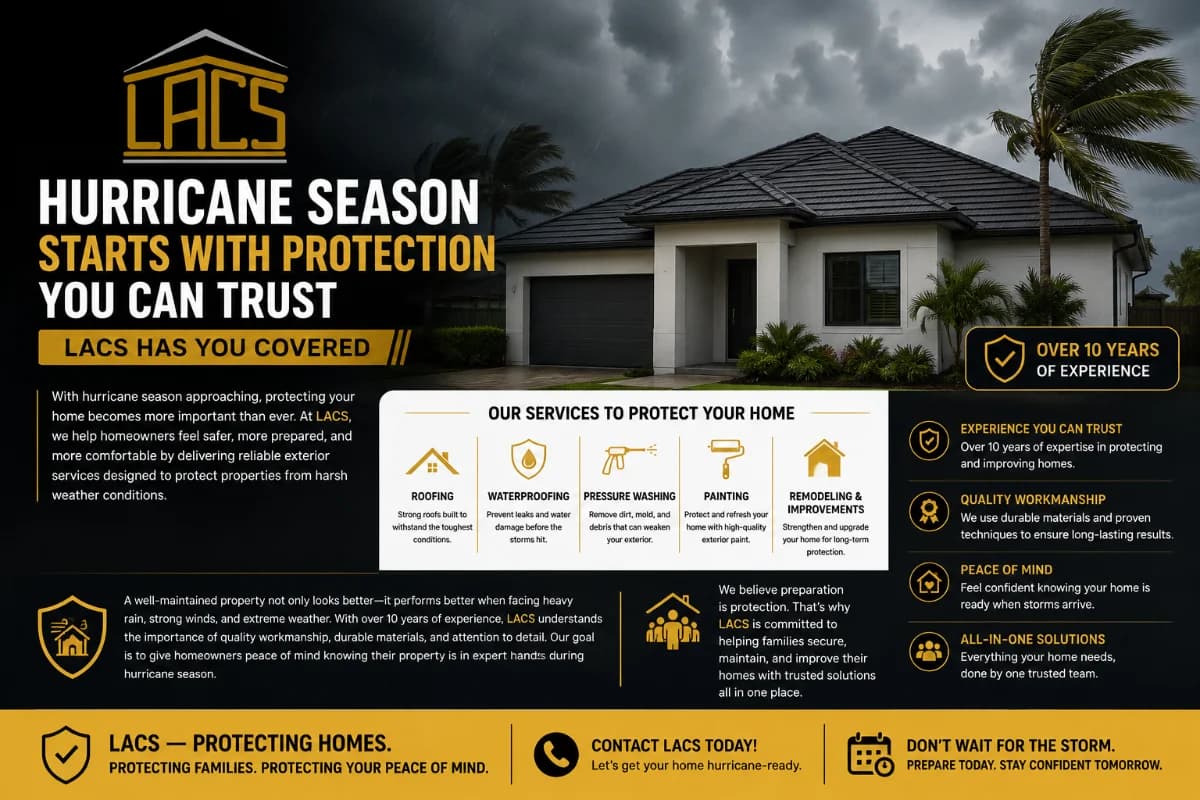
Hurricane Season Starts with Protection You Can Trust- LACS Has You Covered
Prepare before hurricane season: roof checks, waterproofing, drainage, exterior maintenance, and insurance/NFIP basics to reduce storm damage.
Are You Seriously Waiting Until a Storm Is Named to Protect Your Home?
If you wait until hurricane season is already active, you’re gambling with your roof, walls, and wallet. Real protection starts before the first watch or warning—by strengthening weak points, sealing water entry paths, and maintaining exterior surfaces. From roofing and waterproofing to pressure washing, painting, remodeling, and structural improvements, LACS helps your home perform better under extreme weather.
Introduction
A common (and expensive) belief is that “insurance will handle it” if a hurricane hits. The reality is that coverage has limits, deductibles can be brutal, and many losses come from preventable failures—like a tired roof edge lifting, water pushing through unsealed penetrations, or clogged drainage sending runoff where it shouldn’t go.
When you understand how storms actually damage homes, your plan changes: you stop thinking in terms of last-minute plywood and start thinking in system-level protection—roof integrity, waterproofing continuity, surface maintenance, and smart upgrades that reduce storm-driven damage. That’s where proactive work matters most—before storms arrive and contractors get booked out.
Your roof may already be one loose shingle away from a leak, and you won’t know until wind-driven rain is inside your attic. If you delay maintenance and hardening work, storm damage becomes more severe—and your insurance claim becomes harder, slower, and more stressful. Talk to LACS now and lock in a pre-season plan for roofing, waterproofing, pressure washing, painting, remodeling, and structural improvements.

Table of Contents
- What “Protection” Actually Means Before Hurricane Season
- Roofing: The First Failure Point in High Wind and Heavy Rain
- Waterproofing and Drainage: Stop Water Before It Finds a Path
- Pressure Washing and Painting: Maintenance That Prevents Costly Breakdown
- Remodeling and Structural Improvements That Reduce Storm Damage
- Insurance, Flood Coverage, NFIP Waiting Periods, and What “Covered” Really Means
- Travel During Hurricane Season: How to Prepare Your Home Before You Leave
What “Protection” Actually Means Before Hurricane Season
Real hurricane protection is not one product—it’s a chain of small reinforcements that keeps wind from opening the building envelope and keeps water from exploiting tiny gaps. The goal is simple: reduce the chance of damage and reduce the severity if damage happens. That means maintenance plus targeted upgrades.
Most homeowners focus on the dramatic stuff (shutters, sandbags) while ignoring what fails first: aging roof edges, loose flashing, unsealed penetrations, deteriorated paint films, soft wood trim, and poor drainage routes. Hurricanes punish neglected details.
A practical pre-season plan should include:
- Exterior inspection: roof surface/edges, soffits/fascia, wall penetrations
- Water management: gutters/downspouts (if present), grading issues, splash zones
- Surface preservation: cleaning + coatings that slow rot/corrosion
- Upgrade priorities: fix what can cause cascading damage (roof leaks → mold → drywall → electrical)
To better understand how LACS approaches projects with clear scope and predictable scheduling so pre-season work doesn’t drag into peak storm months, see also the article Why Choose LACS for Your Next Project.
Roofing: The First Failure Point in High Wind and Heavy Rain
Your roof is the system most likely to fail first because wind attacks edges and corners while rain exploits any opening. If shingles lift or flashing separates even slightly, wind-driven rain can enter fast—leading to insulation saturation, ceiling stains, mold risk, and damaged decking. Pre-season roofing work is about preventing “small” issues from turning into major claims.
Start with an honest assessment of roof condition—not just age. Look for missing/damaged shingles or tiles, lifted edges, exposed fasteners (on certain systems), cracked sealant at penetrations (vents/chimneys), rusted flashing, soft spots on decking areas near valleys or transitions.
High-value actions before storms:
- Repair compromised areas (don’t “wait and see”)
- Re-secure or replace flashing where movement is visible
- Seal penetrations correctly (not random caulk smears)
- Check attic signs: daylight at penetrations, damp insulation after heavy rain
The point isn’t perfection—it’s reducing the probability that your roof becomes the entry point for catastrophic interior damage.
To better understand the level of craftsmanship and long-term roof care standards LACS has built over years of field work, see also the article A Decade of Excellence. One Trusted Name: LACS.
Waterproofing and Drainage: Stop Water Before It Finds a Path
Water damage during hurricanes isn’t only “flood.” It’s also wind-driven rain pushed sideways into seams around windows/doors, under siding transitions, through wall penetrations, and into hairline cracks that expand under pressure changes. Waterproofing is about continuity—closing the hidden routes water uses when conditions are extreme.
Key risk zones to address before hurricane season:
- Window/door perimeters where sealants have shrunk or separated
- Exterior wall penetrations (hose bibs, conduits, vents)
- Cracks in stucco or masonry joints that channel water inward
- Roof-to-wall transitions where flashing meets vertical surfaces
- Drainage behavior during heavy rain (where water pools or sheets back toward walls)
A strong approach is to walk the property during a hard rain (or right after) to observe flow paths. If water repeatedly hits the same wall base or pools near openings, you’re watching future damage form in real time.
To better understand why disciplined planning matters when coordinating multiple exterior improvements like waterproofing plus repairs without budget surprises, see also the article Why Choose LACS for Your Next Project.
Pressure Washing and Painting: Maintenance That Prevents Costly Breakdown
Pressure washing and painting aren’t just cosmetic—they’re part of storm readiness because they protect materials from accelerated deterioration in humid, salty, storm-prone environments. When grime, algae, or chalky oxidation build up on surfaces, coatings fail sooner; when coatings fail sooner, wood trim swells/rots faster; when trim rots faster, water intrusion gets easier.
Pressure washing done correctly removes contaminants without damaging surfaces. Done poorly (too much pressure too close), it can etch concrete, shred wood fibers, or force water behind materials—so technique matters as much as equipment.
Painting matters because it’s a protective film:
- Seals porous substrates against moisture cycling
- Slows corrosion on metal components
- Reduces UV breakdown that leads to cracking
- Helps reveal early substrate issues during prep (soft spots don’t hide)
Pre-season is ideal timing because you want coatings cured before extended wet weather patterns.
To better understand how consistent exterior maintenance services like pressure washing and painting fit into LACS’s long-term property care approach, see also the article A Decade of Excellence. One Trusted Name: LACS.
Remodeling and Structural Improvements That Reduce Storm Damage
The best time to remodel is not after a storm forces your hand—it’s before hurricane season when you can choose upgrades strategically instead of reactively. Smart remodeling isn’t about luxury; it’s about reducing failure points so your home holds up better under wind loads and heavy rain.
High-impact improvements often include:
- Replacing deteriorated exterior doors or addressing poor seals/alignment
- Upgrading vulnerable exterior trim or soffit/fascia sections
- Reinforcing areas where water repeatedly intrudes (rebuilding damaged substrates correctly)
- Improving exterior transitions where different materials meet (common leak points)
Structural improvements don’t have to be dramatic to matter. A small correction—like rebuilding a rotted corner assembly properly—can prevent wind from grabbing an edge and peeling materials back like a zipper.
The real advantage is compounding: when roofing integrity + waterproofing continuity + maintained surfaces work together, your home doesn’t just look better—it performs better when storms arrive.
To better understand how LACS manages remodeling scopes with clear timelines so projects finish before peak hurricane season, see also the article Why Choose LACS for Your Next Project.
Insurance, Flood Coverage, NFIP Waiting Periods, and What “Covered” Really Means
Homeowners often discover too late that “hurricane insurance” isn’t usually one simple policy. In practice it can involve homeowners coverage (dwelling/contents), separate windstorm provisions or deductibles depending on location/policy language, and flood insurance for rising water events such as storm surge. If you assume everything is covered automatically, you’re setting yourself up for financial shock.
Important realities to review early in the season:
- Hurricane deductibles can be percentage-based and much higher than normal deductibles
- Flood damage is typically excluded from standard homeowners policies
- NFIP flood policies commonly have a waiting period, so buying late may not help for an approaching storm
- Claims are smoother when you have documentation (photos/video) before damage occurs
This is exactly why physical preparation matters even if you have coverage: preventing damage avoids disputes about cause (wind vs flood), reduces claim complexity while you’re dealing with emergency decisions, and protects what no policy truly replaces—time and stability.
To better understand how working with one trusted contractor reduces post-storm chaos by keeping documentation tight and scopes clear, see also the article A Decade of Excellence. One Trusted Name: LACS.
Travel During Hurricane Season: How to Prepare Your Home Before You Leave
If you travel during hurricane season—whether for work trips or vacation—you need a plan that assumes you might be away when storms form quickly. The goal is not panic monitoring; it’s setting your home up so it can handle severe weather with minimal intervention while you’re gone.
Before leaving town:
- Walk the exterior: look for loose items or weak points you’d hate to discover mid-storm
- Confirm drainage behavior: ensure water won’t pool against entry points
- Document condition: quick photos/video of roof lines (from safe vantage points), interiors, valuables
- Line up help: a neighbor/friend who can do a quick check after warnings are issued
- Know your policies: understand what triggers trip cancellation vs interruption if hurricanes affect travel plans
Even if travel insurance provides coverage after a named storm impacts your trip plans (depending on policy terms), it doesn’t protect your home from preventable physical failures while you’re away.
To better understand why pre-scheduled exterior maintenance helps homeowners avoid last-minute scrambling right before travel dates, see also the article Why Choose LACS for Your Next Project.
Is Pre-Season Home Protection Actually Worth Paying For?
Yes—because hurricanes don’t just cause “big obvious” destruction; they exploit small weaknesses that create expensive secondary damage. A minor roof edge failure can lead to soaked insulation and ceilings; a small sealant gap can become interior wall saturation; neglected exterior coatings can accelerate rot that turns into structural repair later. Paying for pre-season protection is essentially paying to avoid compounding costs under emergency conditions—when materials are scarce, schedules are overloaded, and stress pushes people into rushed decisions.
Even if insurance helps after a storm event, deductibles still apply and coverage may exclude certain causes like flood-related loss without separate policies. Pre-season work also improves day-to-day durability in heavy rain seasons—not just during hurricanes—so the benefit isn’t limited to one event window.
With LACS or Without LACS: What’s the Difference?
With LACS:
- You get a coordinated plan across roofing and waterproofing to pressure washing, painting, remodeling, and structural improvements—not disconnected fixes.
- Work is scheduled intentionally so critical items are handled before storms ramp up.
- You reduce avoidable damage pathways that turn one leak into weeks of repairs.
Without LACS:
- Small issues stay open until weather forces an emergency call.
- You end up reacting during peak season when contractor availability tightens fast.
- Damage often spreads beyond the original failure point—raising repair scope and downtime.
Practical conclusion: proactive protection costs less than emergency restoration—and it feels radically different when storms arrive.
📌 Decision If you’re entering hurricane season with an aging roof edge line, questionable seals around openings, dirty surfaces hiding deterioration, or remodeling projects you’ve been postponing “until later,” you’re choosing higher risk on purpose. Every month you delay increases the odds that routine wear turns into storm-driven damage—and once contractors are booked out after landfall, you pay more while waiting longer in unsafe conditions. Act now while choices are still yours.
Conclusion
Hurricane season rewards preparation—and punishes wishful thinking. The strongest strategy isn’t relying on insurance alone or waiting until storms are named; it’s strengthening your home’s real failure points ahead of time so wind and water have fewer ways in.
From roofing integrity and waterproofing continuity to pressure washing, painting protection layers, remodeling fixes, and structural improvements that eliminate weak links—LACS helps homeowners build practical resilience before extreme weather arrives. To better understand how LACS earned trust through consistent results across exterior care and construction services, see also the article A Decade of Excellence. One Trusted Name: LACS.
You’re watching forecasts while knowing your home still has unresolved weak spots—loose edges, failing sealants, worn coatings—and that stress doesn’t go away on vacation or during work travel. If you delay pre-season work, each new storm system raises the chance of preventable damage plus painful insurance headaches. Talk to LACS now and secure your home with targeted upgrades before schedules fill up.