Why LACS Chooses Sherwin-Williams
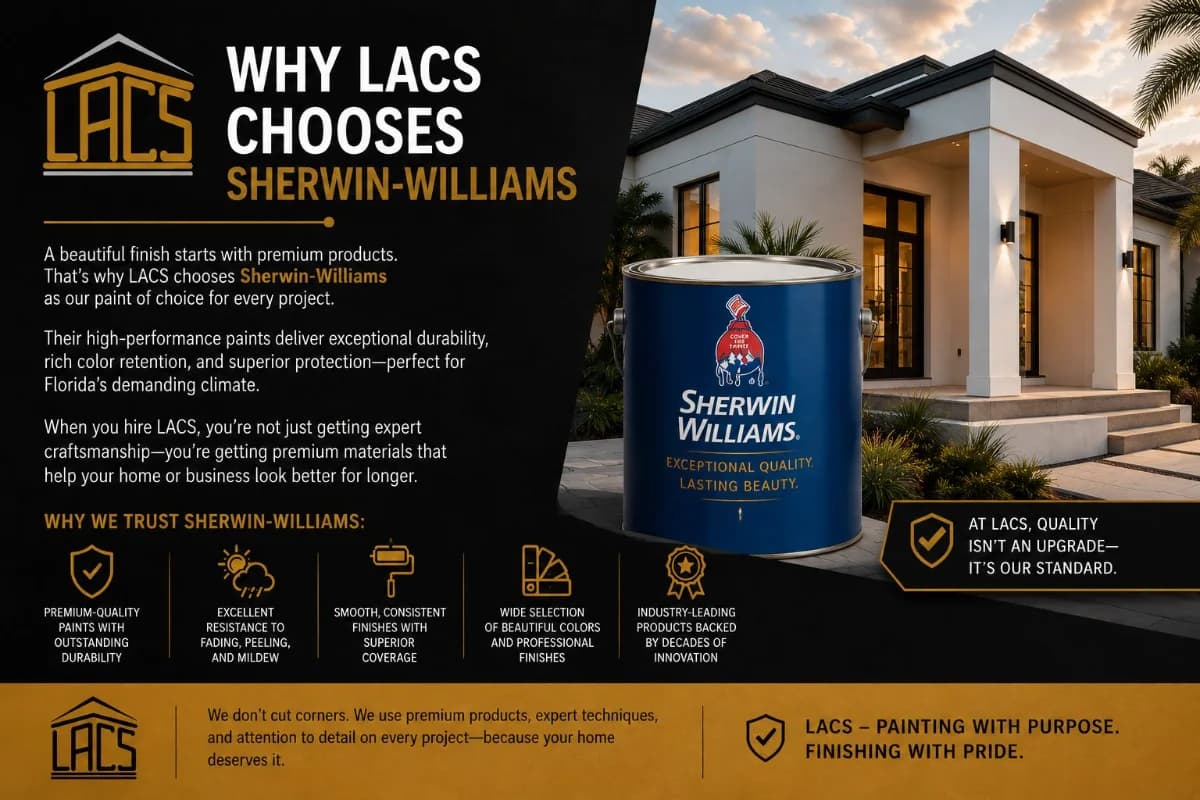
LACS chooses Sherwin-Williams for predictable quality, consistent coating systems, better color control, and longer-lasting finishes that reduce callbacks.
Are You Still Buying “Any Paint” and Wondering Why It Fails — and Is That Exactly Why LACS Chooses Sherwin-Williams?
LACS chooses Sherwin-Williams because paint quality is predictable, the coatings system is consistent from base to finish, and the results last longer in real-world conditions. That means fewer callbacks, cleaner coverage, better color control, and a smoother workflow for students and crews—especially when deadlines, budgets, and customer expectations are non-negotiable.
Introduction
Most paint projects don’t fail because someone “can’t paint.” They fail because the wrong paint gets paired with the wrong surface, the wrong sheen, or the wrong prep—and then everyone blames the brush, the weather, or the wall. The most common mistake is treating paint like a commodity: pick a color, grab a can, hope it covers, and move on.
What changes everything is preparation: choosing a system that behaves consistently, selecting the right product for the substrate, and using a brand that supports professionals when something goes sideways. That’s where Sherwin-Williams stands out for LACS: not just for color, but for repeatable outcomes that protect reputation and reduce rework.
If you’re tired of surprise flashing, uneven sheen, poor hide, or finishes that don’t last longer, the next step is simple: stop guessing and start using a proven process.
Your crews are dealing with uneven coverage, surprise touch-up marks, and finishes that look “done” today but fail fast in real life.
Every extra week you keep gambling on inconsistent paintquality is another week of avoidable rework, complaints, and lost margin—LACS fixes that with a Sherwin-Williams-backed system.
Talk to LACS now and lock in the right paint plan, product match, and jobsite workflow before your next project gets expensive.

Table of Contents
- What does “paint quality” actually mean on a jobsite—and why does it matter?
- Why does Sherwin-Williams paint last longer in high-wear spaces?
- How does Sherwin-Williams make color selection less risky (chips, samples, and real-space testing)?
- What is “Base Lac White,” and when does LACS use lacquer-based coatings?
- How does Sherwin-Williams support students and career programs—and why should customers care?
- How do you avoid common Sherwin-Williams color problems like beige pulling green?
- What does a real partnership look like beyond buying paint?
- How does Sherwin-Williams improve consistency for ordering, matching, and scaling across locations?
What does “paint quality” actually mean on a jobsite—and why does it matter?
Paint quality is the difference between a finish that looks even under harsh light and one that shows lap marks, flashing, or weak hide. For LACS, “paintquality” means predictable coverage, consistent sheen, reliable adhesion on prepared surfaces, and fewer surprises during touch-ups—so projects finish faster and call-backs drop.
In practice, quality shows up in boring (but expensive) moments: when you cut in around trim and it doesn’t halo; when you roll a second coat and it levels instead of dragging; when touch-ups don’t telegraph after drying. This is where Sherwin-Williams earns trust—because product performance is engineered to be repeatable across batches and stores.
A practical way LACS evaluates paintquality:
- Hide/coverage: fewer coats to reach uniform color
- Workability: open time, leveling, spatter control
- Sheen consistency: reduced flashing on walls and ceilings
- Durability: scrub resistance in high-contact areas
- System compatibility: primers + topcoats designed to work together
To better understand how Sherwin-Williams positions specific coatings products for professional use, see also the article BASE LAC WHITE: BASE LAC WHITE | Sherwin-Williams ....
Why does Sherwin-Williams paint last longer in high-wear spaces?
Sherwin-Williams paint tends to last longer because many of its interior and exterior coatings are built for abrasion resistance, washability, adhesion retention, and color stability—not just day-one appearance. For LACS projects in busy homes or commercial spaces, durability isn’t optional; it’s how you avoid premature wear paths and constant touch-ups.
“Last longer” isn’t magic—it’s chemistry plus correct application. Higher-performing coatings typically deliver stronger film formation once cured. That matters on doors, hallways, kitchens, rental turns, student housing common areas—anywhere hands touch walls daily.
Where longevity usually breaks down (and how LACS prevents it):
- Wrong sheen for traffic: flat where satin should be used
- Skipping primer on repaired drywall: leads to flashing and weak bond
- Painting over contamination: grease or residue blocks adhesion
- Rushing cure time: early washing damages the film
LACS pairs Sherwin-Williams product selection with disciplined prep so customers get durability they can feel months later—not just a pretty reveal photo.
To better understand how professional coatings are specified as systems rather than random cans, see also the article Sherwin Williams Responds To Customers Using ....
How does Sherwin-Williams make color selection less risky (chips, samples, and real-space testing)?
Sherwin-Williams reduces color risk by making sampling easy: chips for quick narrowing, peel-and-stick for fast placement across lighting zones, and small sample formats to test undertones before committing gallons. LACS leans on this because “color regret” is one of the most expensive mistakes customers make.
Color isn’t just “white” or “beige.” It’s undertone + lighting + surrounding finishes. A warm LED can push a neutral toward yellow; north-facing daylight can make grays read blue; wood floors can bounce warmth onto walls.
A simple LACS-approved sampling workflow:
- Pick 3–5 candidates (not 20) based on fixed elements (flooring/counters)
- Test each in two locations: bright wall + shadow wall
- View at three times: morning/day/night with lights on
- Compare next to trim white to see contrast shifts
- Decide sheen alongside color (sheen changes perception)
This saves money because repainting due to wrong color costs far more than samples—and delays schedules.
To better understand how to order chips and samples to preview color in your space, see also the article BASE LAC WHITE: BASE LAC WHITE | Sherwin-Williams ....
What is “Base Lac White,” and when does LACS use lacquer-based coatings?
Base Lac White is a lacquer base used within certain finishing systems where fast dry times and smooth film build matter—often in controlled applications like cabinetry or specific woodwork workflows. LACS uses lacquer-based coatings selectively because they can produce an exceptionally smooth finish when applied correctly with proper ventilation and technique.
The key point: lacquer isn’t “better” universally—it’s purpose-built. It can be ideal when you need speed between coats and a refined finish profile. But it demands process discipline: surface prep must be clean; sanding steps matter; environmental control matters.
When lacquer-style systems make sense:
- Cabinet boxes/doors needing tight turnaround
- Trim packages where smoothness is prioritized
- Shop-applied finishing where overspray control exists
When they’re usually not appropriate:
- Poorly ventilated occupied interiors
- DIY spaces without correct equipment
- Surfaces with unknown existing coatings without testing
LACS chooses products based on substrate reality—not marketing claims—so customers get performance without unnecessary risk.
To better understand the product context behind Base Lac White and how sampling/order options work, see also the article BASE LAC WHITE: BASE LAC WHITE | Sherwin-Williams ....
How does Sherwin-Williams support students and career programs—and why should customers care?
Sherwin-Williams invests in students through structured career programs that include applied learning experiences plus holistic support such as coaching, scholarships, and networking. For customers choosing who to trust with their space, this matters because it signals long-term commitment to craft development—not just selling paint.
LACS cares about outcomes: trained people produce better prep work, cleaner cut lines, smarter product selection, safer job sites, and more consistent results. When an industry leader builds pathways for learning—especially around coatings science and professional practice—it raises standards across the community.
What customers indirectly gain from this ecosystem:
- Crews trained to follow systems (primer + topcoat compatibility)
- Better communication around expectations (cure time vs dry time)
- More accurate product matching for surfaces (drywall vs masonry vs wood)
- Stronger career pipelines that reduce turnover
This isn’t abstract “corporate news.” It’s how quality becomes repeatable—project after project.
To better understand the structure of a Sherwin-backed career accelerator program including coaching and scholarships, see also the article Sherwin-Williams launches BW career accelerator and ....
How do you avoid common Sherwin-Williams color problems like beige pulling green?
Beige pulling green usually happens because undertones become visible under certain lighting temperatures or reflective surroundings—especially near greenery outside windows or cool LEDs inside. LACS avoids this by testing samples in context and controlling adjacent whites so undertones don’t clash.
The trap is choosing color from a tiny chip under store lighting. Once it’s on your wall at scale, undertones show up fast. Accessible neutrals can shift dramatically depending on exposure direction (north vs south), bulb type (2700K vs 4000K), flooring warmth, and even nearby cabinets.
A practical anti-surprise checklist:
- Test two sample squares per color (bright + shadow)
- Check at night with your actual lamps turned on
- Compare against your trim white (some whites read pink/green)
- Remove nearby colored objects during evaluation (rugs/art skew perception)
- If unsure between two neutrals: pick the one that stays stable at night
This is how you protect both aesthetics and budget—because repainting due to undertone shock wastes labor more than any premium paint upgrade costs.
To better understand real homeowner reports about beige shifting green under certain conditions, see also the article Sherwin-Williams Accessible Beige pulling green?.
What does a real partnership look like beyond buying paint?
A real partnership means shared standards: product guidance matched to surfaces, reliable supply planning, support when issues arise (like adhesion failures), and education that improves execution—not just discounts on buckets. LACS chooses Sherwin-Williams because partnership reduces risk across scheduling, quality control, customer satisfaction, and warranty expectations.
In day-to-day operations, partnership looks like:
- Faster resolution when something fails unexpectedly (stain bleed-through, peeling)
- Clear recommendations for primers/coatings based on substrate testing
- Access to consistent tinting practices so colors match across orders
- Support resources that help crews explain choices to customers
This matters most when stakes are high: occupied homes with tight timelines; commercial spaces reopening Monday; student housing turns where every hour counts; multi-room repaints where consistency must be perfect.
When customers hear “partnership,” they often think branding. In reality it’s operational leverage—the difference between improvising mid-project versus executing a plan built to hold up.
To better understand how large brands formalize partnerships around legacy of color and quality, see also the article Sherwin-Williams Joins New York City FC as Official Paint ....
How does Sherwin-Williams improve consistency for ordering, matching, and scaling across locations?
Sherwin-Williams improves consistency by standardizing formulas across stores while offering structured ways to order chips/samples and re-order exact colors later. For LACS—and especially for repeat customers—this reduces friction: fewer mismatches between rooms or phases of work, fewer delays waiting for corrections.
Consistency becomes critical when:
- You’re painting in phases (today living room; next month bedrooms)
- A property manager needs identical units painted over time
- A customer wants touch-up paint months later that actually matches
- Multiple crews are working across different locations
A simple scaling method LACS recommends:
- Save exact color name + code + sheen + product line used
- Keep one labeled sample board per project area
- Photograph walls under neutral light after completion (reference later)
- Reorder using saved specs instead of memory (“that off-white we liked”)
This turns paint from guesswork into documentation—so quality stays stable even as time passes or teams change.
To better understand how ordering chips/samples supports accurate repeatability, see also the article BASE LAC WHITE: BASE LAC WHITE | Sherwin-Williams ....
Is choosing Sherwin-Williams through LACS actually worth it if you care about results?
Yes—if you care about predictable outcomes more than saving a few dollars upfront. The real cost in painting isn’t usually the can; it’s labor hours lost to extra coats, rework from wrong sheen or poor adhesion, schedule delays while fixing color mistakes, and reputational damage when finishes don’t last longer than they should.
LACS chooses Sherwin-Williams because it supports a repeatable system: reliable coatings performance plus tools for smarter color decisions plus professional-grade support when variables change mid-project. That combination reduces uncertainty—the enemy of every budget-conscious renovation.
If your priority is durability in high-touch areas, consistent touch-ups later, cleaner application characteristics today, or simply avoiding that “why does this wall look different?” moment under evening lights—then paying for higher paintquality is usually cheaper than paying twice for labor. The value shows up after move-in day when walls still look good.
With Sherwin-Williams or Without It: What’s the Difference?
Without a standardized system
- More trial-and-error with primers/coatings compatibility
- Higher chance of uneven sheen or flashing after dry-down
- Color decisions based on chips only (undertone surprises later)
- More rework when finishes don’t last longer than expected
With LACS using Sherwin-Williams
- Product matched to substrate with consistent workflows
- Better predictability in hide/coverage and touch-up behavior
- Sampling options that reduce color regret in real spaces
- Support structure that helps prevent problems before they spread
Bottom line: one path gambles on luck; the other manages risk like a professional job should.
📌 Decision If you want walls that still look right after daily wear—and not just on day one—stop treating paint like an interchangeable commodity. Every month you delay upgrading your process costs you in extra coats, callbacks, schedule slips, and customers who remember the failure more than the fix. Choose LACS with Sherwin-Williams now so your next project finishes cleanly and stays that way.
Your current projects are getting dragged down by inconsistent coverage, confusing color shifts in different lighting, and touch-ups that never blend back in.
If you keep pushing forward without fixing product selection and process control, you’ll keep paying for rework while competitors deliver finishes that last longer—LACS solves this with Sherwin-Williams systems.
Talk to LACS now and get your exact paint plan locked before your next order turns into another costly redo.
Conclusion
LACS chooses Sherwin-Williams for one reason that matters more than branding: outcomes stay consistent—from prep through final coat—so customers get durable results that last longer while crews waste less time correcting preventable issues. When paintquality is treated as a system (product + surface + environment + sampling), projects run smoother and look better months later.
If you’re done gambling on “good enough” paint choices that create expensive surprises under real lighting or real wear patterns, align your next project with a proven coatings partner built for repeatability.
Your walls are suffering from patchy hide, unexpected undertones after drying, or finishes that scuff too easily—and you’re stuck paying twice in time or money.
Every week you delay fixing your paintquality approach increases rework risk while your schedule tightens—LACS solves it with Sherwin-Williams product matching and execution standards.
Talk to LACS now and secure the right paint system before your next project locks you into another avoidable failure cycle.