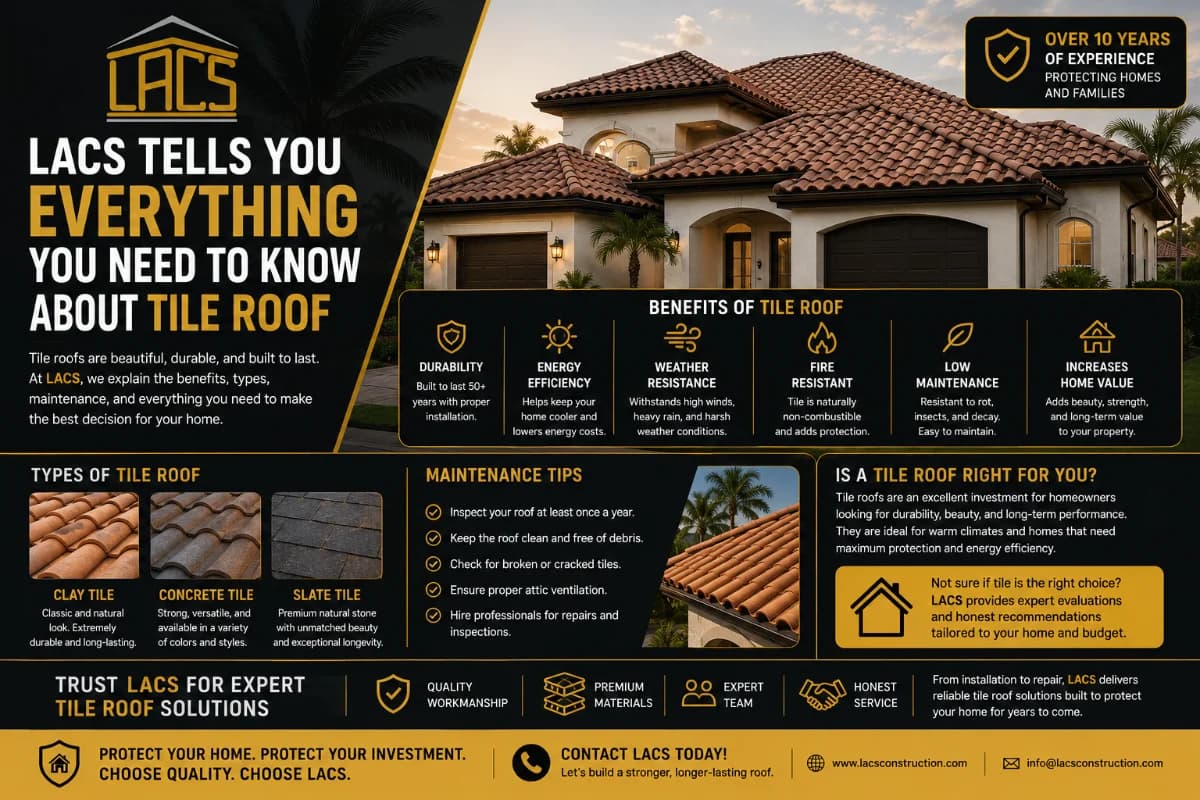
LACS Tells You Everything You Need to Know About Tile Roofs
Learn how tile roof systems work, clay vs concrete options, real pros and cons, common failures, and maintenance steps to prevent leaks in Florida.
Are Tile Roofs Really Worth It, or Are You About to Buy a Problem?
A tile roof is absolutely worth it when your home’s structure can support the weight and you commit to basic upkeep. Tile delivers long lifespan, fire resistance, and strong curb appeal—but it punishes sloppy installation and ignored maintenance. If you want tile, learn how to care of it early, not after leaks start.
Introduction
A common belief is that a tile roof is “set it and forget it” because tiles are tough and long-lasting. The reality is more specific: the tile itself is durable, but the system under it—underlayment, flashing, fasteners, and ventilation—determines whether you get decades of performance or recurring repairs.
When homeowners understand how tile roofing works, they stop wasting money on cosmetic fixes and start protecting the parts that actually fail first. That changes everything: inspections become targeted, cleaning becomes safer, and repairs become smaller instead of turning into expensive tear-offs.
Your tile roof might already be showing cracked tiles, slipped pieces after wind, or stains that won’t wash off—and every rainy week makes the risk feel personal. Waiting can turn a small underlayment issue into rotten decking, interior drywall damage, and mold cleanup that costs far more than a repair. Talk to LACS now and get a tile-roof-focused plan that stops leaks, prevents breakage, and protects your home before the next storm.

Table of Contents
- What Exactly Is a Tile Roof System (Not Just “Tiles”)?
- Clay vs Concrete vs Slate-Look: Which Tile Material Fits Your Home?
- Pros and Cons Homeowners Don’t Hear Until After Installation
- How to Care of It: The Tile Roof Maintenance Routine That Prevents Leaks
- Common Tile Roof Failures (And What They Actually Mean)
- Installation Reality Check: What a Good Roofer Does Differently
- Is a Tile Roof a Smart Investment in Florida Heat, Wind, and Storm Season?
- With Pro Maintenance or Without It: What’s the Difference?
What Exactly Is a Tile Roof System (Not Just “Tiles”)?
A tile roof isn’t just rows of clay or concrete tiles—it’s a layered roofing system where underlayment and flashing do most of the waterproofing. Tiles shed UV and impact, but water management depends on details at valleys, penetrations, edges, and transitions. If those components fail, the strongest tile won’t save you from leaks.
Most homeowners look up and see “tile,” but pros see a system:
- Decking (wood substrate): must be sound and properly fastened
- Underlayment: the true water barrier; its lifespan often sets the roof’s service interval
- Flashing around chimneys, walls, skylights, and pipe boots: leak-prone if poorly detailed
- Battens/fasteners/foam adhesives depending on style and code requirements
- Ridge/hip caps with proper closure: critical for wind resistance and ventilation balance
This is why two homes can have the same-looking tiles but totally different durability. A beautiful tile surface can hide failing underlayment until staining appears indoors.
To better understand how disciplined project scope and scheduling prevent “hidden system” mistakes on roofs, see also the article Why Choose LACS for Your Next Project.
Clay vs Concrete vs Slate-Look: Which Tile Material Fits Your Home?
Clay tiles excel at color stability and classic style; concrete tiles win on cost and impact resistance; slate-look options mimic high-end aesthetics with different weight and handling needs. The best material depends on structure load capacity, local wind requirements, budget for installation quality, and how much maintenance you’re willing to do.
Here’s how the main types compare in real homeowner terms:
- Clay tile: made from natural clay fired at high temperatures; iconic profiles (barrel/S-shaped). It holds color well but can be brittle under foot traffic if mishandled.
- Concrete tile: made from cementitious materials; typically heavier than clay; often more affordable. Color can weather over time depending on finish.
- Slate (natural) or slate-look tile: natural slate is premium and heavy; slate-look products vary widely by manufacturer. Great look, but details matter at edges and penetrations.
Also consider style profiles you’ll see in neighborhoods: flat tiles for modern lines, barrel tiles for Mediterranean looks, and interlocking tiles designed for higher wind performance.
To better understand what long-term workmanship consistency looks like when you’re trusting a contractor with expensive exterior materials, see also the article A Decade of Excellence. One Trusted Name: LACS.
Pros and Cons Homeowners Don’t Hear Until After Installation
Tile roofing’s biggest advantages are longevity potential, fire resistance, energy performance, and curb appeal—but its downsides show up when installation shortcuts meet heavy materials. Tile can crack from careless walking, repairs require matching profiles/colors, and underlayment replacement is inevitable even if tiles still look perfect.
Pros homeowners usually love
- Durability: tiles can last decades when installed correctly
- Fire resistance: especially valuable in wildfire-prone regions
- Energy efficiency: airspace under tile can reduce heat transfer compared to some shingles
- Aesthetic range: many styles that elevate resale appeal
Cons owners discover later
- Weight: structure must support it; retrofits may need engineering
- Fragility under traffic: one wrong step can break multiple tiles
- System dependency: underlayment/flashing failures cause leaks even when tiles look fine
- Repair complexity: finding matching tiles years later isn’t always easy
If you’re comparing against asphalt shingles or metal roofing, remember: tile’s “long life” is real—but only when the entire assembly is built like a system.
To better understand how choosing the right team reduces rework across complex exterior projects, see also the article Why Choose LACS for Your Next Project.
How to Care of It: The Tile Roof Maintenance Routine That Prevents Leaks
To care of it properly, treat your tile roof like a protective shell over a waterproof layer: keep water flowing off cleanly, stop debris from trapping moisture, replace broken tiles fast, and inspect flashing/underlayment on a schedule. Most “tile roof problems” start small—then spread when ignored for one storm season too long.
A practical routine that works:
-
Visual check from the ground monthly
Look for slipped tiles, missing ridge caps, or uneven lines after wind. -
Clean gutters and valleys seasonally
Debris dams force water sideways under tiles. -
Address cracked/broken tiles immediately
One broken piece becomes a pathway for water intrusion during driven rain. -
Avoid pressure washing unless you know the system
High pressure can break tiles or force water into laps; use appropriate methods. -
Professional inspection every 1–2 years (and after major storms)
A pro checks flashing details, penetrations (pipe boots), ridge closures, and signs of underlayment fatigue.
If you remember only one thing about how to care of it: tile is durable; neglected drainage is not.
To better understand what consistent exterior maintenance standards look like across services like roof care and cleaning, see also the article A Decade of Excellence. One Trusted Name: LACS.
Common Tile Roof Failures (And What They Actually Mean)
Most tile roof failures aren’t “the whole roof going bad”—they’re localized issues that signal stress in the system underneath. Cracked tiles often mean impact or foot traffic; repeated leaks near penetrations usually point to flashing problems; widespread staining can indicate trapped moisture or aging underlayment approaching end-of-life.
Watch for these patterns:
- Cracked or chipped tiles: hail/impact damage or improper walking paths during service work
- Slipped tiles: fastening issues, failed foam adhesive (where used), or battens problems
- Leaks at skylights/chimneys/walls: flashing design or installation errors are common culprits
- Efflorescence (white powdery staining) on concrete tiles: moisture movement through material; not always structural but worth evaluating
- Sagging lines: possible decking issues—this is urgent because weight + moisture accelerates deterioration
The key is interpretation. Replacing a few tiles without addressing why they broke is how homeowners end up paying twice.
To better understand how experienced teams prevent repeat failures by fixing root causes instead of symptoms, see also the article Why Choose LACS for Your Next Project.
Installation Reality Check: What a Good Roofer Does Differently
A good tile roofer doesn’t just “lay tiles straight”—they engineer water shedding, wind resistance, movement control, and long-term serviceability. The difference shows up in underlayment selection, flashing craftsmanship, correct fastening/adhesive methods per code, clean valley geometry, and careful handling that prevents micro-cracks.
Here’s what separates strong installs from future headaches:
- Underlayment matched to climate (heat exposure matters) with correct laps/seams
- Flashing done as custom metalwork, not improvised patches around penetrations
- Correct fastening pattern for your wind zone; not every tile gets treated the same in high-wind areas
- Valleys built to move water fast, keeping debris from collecting under edges
- Walk paths planned, using proper pads/techniques so tiles aren’t crushed during install
Ask direct questions before you sign:
- What underlayment are you using—and why?
- How do you handle valleys and wall transitions?
- How will repairs be handled if matching tiles are discontinued?
To better understand how disciplined planning protects budgets and timelines on complex builds, see also the article Why Choose LACS for Your Next Project.
Is a Tile Roof a Smart Investment in Florida Heat, Wind, and Storm Season?
Yes—when installed to local wind requirements with quality underlayment and maintained proactively, a tile roof can be an excellent Florida fit. Tile handles heat well, offers strong fire resistance benefits where relevant, and resists UV degradation better than many materials. But storms expose weak flashing fast.
Florida-specific realities homeowners should factor in:
Heat loads punish cheap components first. Even if your tiles look great from the street, sun exposure accelerates aging in sealants at penetrations and stresses underlayment over time if ventilation is poor.
Wind events test edge details—rakes/eaves/ridges—and any area where uplift can start peeling components back. After major storms, missing or shifted ridge caps are an early warning sign that should be addressed immediately.
Salt air near coasts can corrode certain metals if wrong flashing materials are used. That’s why specifying compatible metals matters as much as choosing clay versus concrete.
To better understand what long-term reliability looks like when one contractor owns quality across exterior work, see also the article A Decade of Excellence. One Trusted Name: LACS.
With Pro Maintenance or Without It: What’s the Difference?
With proactive maintenance you catch small failures before they become leaks; without it you usually discover problems only after interior damage appears. Tile roofs rarely fail all at once—they fail through neglected details like clogged valleys, broken pieces left in place too long, or flashing that slowly opens up over seasons.
With pro maintenance
- Regular inspections after storms identify slipped/cracked tiles early
- Valleys/gutters stay clear so water doesn’t back up under tile edges
- Flashing issues get corrected before they wet decking or insulation
Without pro maintenance
- Minor cracks turn into recurring leak points during driven rain
- Debris dams cause hidden moisture that rots wood over time
- Repairs become reactive—and more expensive—because damage spreads unseen
Practical conclusion: if you chose tile for longevity, maintenance is how you actually collect that value instead of donating it to avoidable repairs.
To better understand how consistent service standards reduce repeat issues across home exterior systems, see also the article A Decade of Excellence. One Trusted Name: LACS.
Conclusion
A tile roof can be one of the best-looking—and longest-lasting—roofing choices homeowners make, but only when you respect what makes it work: underlayment integrity, precise flashing details, smart drainage paths, and safe handling that avoids breakage.
If you take nothing else away from this guide on how to care of it: inspect after storms, keep valleys/gutters clean, replace broken tiles quickly, and don’t ignore small leaks near penetrations—they’re rarely “small” for long. To better understand how LACS approaches reliable project outcomes with clear scope and accountability, see also the article Why Choose LACS for Your Next Project.
You’re dealing with cracked tiles, mystery leaks around vents or valleys, or stains that keep coming back—and every storm makes you wonder what’s happening underneath your roof. Waiting risks soaked insulation, damaged decking, ruined ceilings, and repair bills that multiply fast. Talk to LACS now and lock in an inspection-and-repair plan that protects your tile roof before the next downpour.